bawo
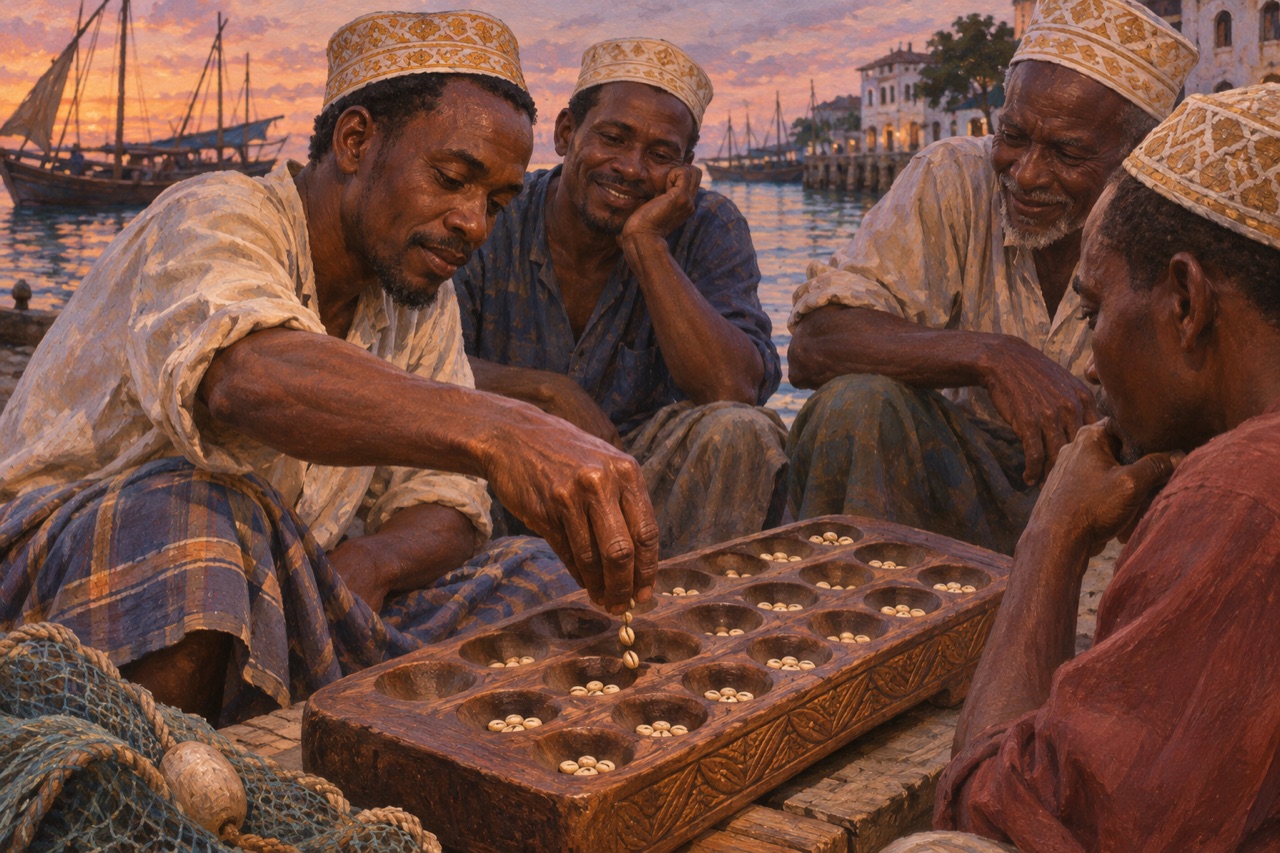
In Malawi, a local form known as bawo brings mainly men together under large trees and in other communal spots as a leisure activity. The game relies on holes (pockets) and stones, and its strategic core is anticipating moves to remove an opponent’s stones. UNESCO documentation notes that it is played predominantly by men under big trees, and matches are arranged voluntarily during free time.
What becomes a game: a set of holes and a number of stones become a competitive system once rules govern how stones are sown and captured. The central element determining outcomes is the players’ ability to plan ahead about which holes to distribute stones into and in what sequence.
How it is played: play proceeds by distributing stones into holes and using those moves to eliminate the opponent’s stones according to local rules. While traditional wooden boards are common, digital versions have also been observed. Although related to the broader mancala/bao family, the Malawian bawo displays distinctive procedures for sowing and capture that mark it as a specific local variant.
What draws the men: beyond strategic challenge, the activity functions as a social setting—jokes, conversation, and banter during matches are integral. It serves both as competitive play and as a primarily male social gathering.
Spread and sources: bawo has spread nationwide in Malawi, appearing in both handcrafted wooden boards and electronic adaptations. For further detail, see the UNESCO submission: https://ich.unesco.org/doc/src/26206-EN.pdf